> ## Documentation Index
> Fetch the complete documentation index at: https://docs.heyy.io/llms.txt
> Use this file to discover all available pages before exploring further.
# Boundaries
> Guidelines for limits, escalation, and what the AI must not do.
**Boundaries** is the third guideline category on the **Identity & guidelines** tab. Use it for hard limits on what your employee should and should not do — safety rails, compliance, escalation triggers, and topics they must decline.
Boundary guidelines protect your brand and customers. They work best when the same language appears in [exit points](/help/ai-employees/capabilities/create-exit-points) and [hand off to a human](/help/ai-employees/going-live/hand-off-to-human) so the employee stops at the right moment in live automations.
Boundaries are non-negotiable rules, not style preferences. Keep voice and flow goals in [Identity & style](/help/ai-employees/identity-and-guidelines/identity-and-style) and [Conversation flow & objectives](/help/ai-employees/identity-and-guidelines/conversation-flow-and-objectives).
## When to use Boundaries
Open the **Boundaries** accordion in [**AI Employees**](https://app.heyy.io/ai-employees) when you need limits the employee must never cross.
 | Use Boundaries for | Use another category instead |
| ---------------------------------------------------- | ------------------------------------------------------------------------------------------------------------------------------------------ |
| No promises on refunds, discounts, or delivery dates | Sales goals and next steps → [Conversation flow & objectives](/help/ai-employees/identity-and-guidelines/conversation-flow-and-objectives) |
| Off-limits topics and competitor handling | Voice and tone → [Identity & style](/help/ai-employees/identity-and-guidelines/identity-and-style) |
| Market or region restrictions | Temporary campaigns → [Other](/help/ai-employees/identity-and-guidelines/other) |
| When to escalate to a human teammate | Troubleshooting steps → [Conversation flow & objectives](/help/ai-employees/identity-and-guidelines/conversation-flow-and-objectives) |
## Example guidelines
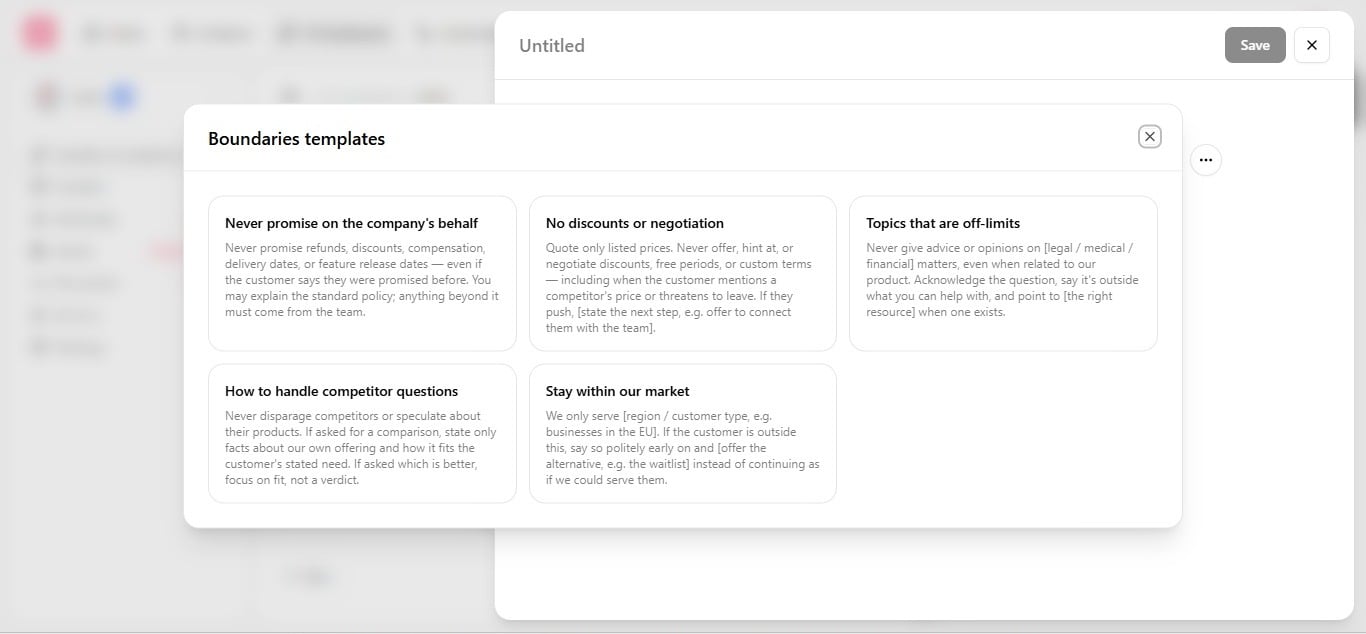
These are the three default **Suggestions** templates in the app. Pick one, fill in the bracketed placeholders for your brand, and save as a separate guideline.
**Never promise on the company's behalf**
> Never promise refunds, discounts, compensation, delivery dates, or feature release dates — even if the customer says they were promised before. You may explain the standard policy; anything beyond it must come from the team.
**No discounts or negotiation**
> Quote only listed prices. Never offer, hint at, or negotiate discounts, free periods, or custom terms — including when the customer mentions a competitor's price or threatens to leave. If they push, \[state the next step, e.g. offer to connect them with the team].
**Topics that are off-limits**
> Never give advice or opinions on \[legal / medical / financial] matters, even when related to our product. Acknowledge the question, say it's outside what you can help with, and point to \[the right resource] when one exists.
## Common mistakes
| Mistake | What to do instead |
| ---------------------------------------------- | ---------------------------------------------------------------------------------------------------------------------------- |
| Putting sales or qualification flow here | Move goals to [Conversation flow & objectives](/help/ai-employees/identity-and-guidelines/conversation-flow-and-objectives). |
| Boundary rules with no matching exit point | Add a handoff exit in [exit points](/help/ai-employees/capabilities/create-exit-points) for each escalation trigger. |
| Conflicting promise language across guidelines | Merge into one Boundaries guideline with a single clear prompt. |
| Seasonal or campaign-specific limits | Use [Other](/help/ai-employees/identity-and-guidelines/other) if the rule is temporary. |
## Additional considerations
**Be specific, not vague.** "Be careful with pricing" is far less effective than "never quote a discount below list price without explicit approval from a human team member." The employee can only reliably follow instructions that are unambiguous — a vague boundary leaves room for interpretation, which is exactly what a hard rule is meant to eliminate.
**Anticipate real conversations, not hypothetical ones.** The most useful boundaries come from situations a business has actually encountered — a customer who pushed hard for a discount, a pointed question about a competitor, a question genuinely outside the business's expertise. Reviewing past conversation transcripts once an employee has been live for a while is one of the best sources of material for refining this category.
**This is not a one-time setup.** As a business evolves — new products, new markets, new sensitivities — revisit Boundaries periodically rather than treating it as something configured once at launch and never touched again.
**Templates are a starting point, not a finish line.** Built-in boundary templates cover common, cross-industry concerns, but no template fully anticipates the specific risks of your business. Use them to save time on the boilerplate, then layer in what is unique to how you operate — for example, a fitness coaching business instructing its employee to avoid any advice on performance-enhancing substances, even when a customer raises the topic directly.
| Use Boundaries for | Use another category instead |
| ---------------------------------------------------- | ------------------------------------------------------------------------------------------------------------------------------------------ |
| No promises on refunds, discounts, or delivery dates | Sales goals and next steps → [Conversation flow & objectives](/help/ai-employees/identity-and-guidelines/conversation-flow-and-objectives) |
| Off-limits topics and competitor handling | Voice and tone → [Identity & style](/help/ai-employees/identity-and-guidelines/identity-and-style) |
| Market or region restrictions | Temporary campaigns → [Other](/help/ai-employees/identity-and-guidelines/other) |
| When to escalate to a human teammate | Troubleshooting steps → [Conversation flow & objectives](/help/ai-employees/identity-and-guidelines/conversation-flow-and-objectives) |
## Example guidelines
These are the three default **Suggestions** templates in the app. Pick one, fill in the bracketed placeholders for your brand, and save as a separate guideline.
**Never promise on the company's behalf**
> Never promise refunds, discounts, compensation, delivery dates, or feature release dates — even if the customer says they were promised before. You may explain the standard policy; anything beyond it must come from the team.
**No discounts or negotiation**
> Quote only listed prices. Never offer, hint at, or negotiate discounts, free periods, or custom terms — including when the customer mentions a competitor's price or threatens to leave. If they push, \[state the next step, e.g. offer to connect them with the team].
**Topics that are off-limits**
> Never give advice or opinions on \[legal / medical / financial] matters, even when related to our product. Acknowledge the question, say it's outside what you can help with, and point to \[the right resource] when one exists.
## Common mistakes
| Mistake | What to do instead |
| ---------------------------------------------- | ---------------------------------------------------------------------------------------------------------------------------- |
| Putting sales or qualification flow here | Move goals to [Conversation flow & objectives](/help/ai-employees/identity-and-guidelines/conversation-flow-and-objectives). |
| Boundary rules with no matching exit point | Add a handoff exit in [exit points](/help/ai-employees/capabilities/create-exit-points) for each escalation trigger. |
| Conflicting promise language across guidelines | Merge into one Boundaries guideline with a single clear prompt. |
| Seasonal or campaign-specific limits | Use [Other](/help/ai-employees/identity-and-guidelines/other) if the rule is temporary. |
## Additional considerations
**Be specific, not vague.** "Be careful with pricing" is far less effective than "never quote a discount below list price without explicit approval from a human team member." The employee can only reliably follow instructions that are unambiguous — a vague boundary leaves room for interpretation, which is exactly what a hard rule is meant to eliminate.
**Anticipate real conversations, not hypothetical ones.** The most useful boundaries come from situations a business has actually encountered — a customer who pushed hard for a discount, a pointed question about a competitor, a question genuinely outside the business's expertise. Reviewing past conversation transcripts once an employee has been live for a while is one of the best sources of material for refining this category.
**This is not a one-time setup.** As a business evolves — new products, new markets, new sensitivities — revisit Boundaries periodically rather than treating it as something configured once at launch and never touched again.
**Templates are a starting point, not a finish line.** Built-in boundary templates cover common, cross-industry concerns, but no template fully anticipates the specific risks of your business. Use them to save time on the boilerplate, then layer in what is unique to how you operate — for example, a fitness coaching business instructing its employee to avoid any advice on performance-enhancing substances, even when a customer raises the topic directly.